Background
The client groups of Monash University Library Japanese collection include academics and students from different faculties with and without Japanese skills. Melbourne Centre for Japanese Language Education (MCJLE) also established their resource centre in the library for the teachers of Japanese in 1997. In addition, there are information needs by people outside Monash community. The client's language skills will vary from proficient to basic in both Japanese and English. Due to the lack of human, material and financial resources in this area it is not possible to meet the needs of all the client groups. An Internet Homepage was therefore selected to substitute the resources by linking with information and databases offered on the Internet. This type of service delivery is more cost effective and accessible to any clients regardless of time and location.
Population and Sampling
The Monash Japanese Client groups are divided into three groups: undergraduates, postgraduate and academics. Each group is further divided by their area of discipline: language teaching, Japanese Studies and other areas, and by the first language of the members (English or Japanese).
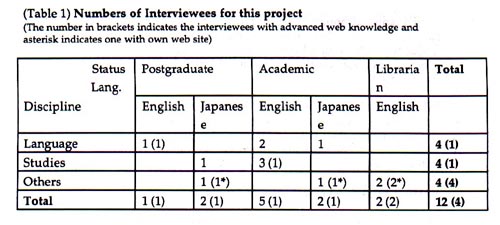
Seven academics and three postgraduates were chosen for interview because they determine the directions of research, and therefore the nature of library resources. They are also the ones who usually require in-depth Japanese information which current library resources do not cover. Those selected interviewees were a good representation of the diverse Monash Japanese clients groups. Their ages ranged between early thirties and early fifties. Two Monash librarians who were engaged in library web development and Internet training were also interviewed because of their expertise. Half of the interviewees had advanced web skills, five with computer knowledge and three had their own web site (Table 1).
Purposes of the WWW use
The participants were asked their general perceptions of the Internet. They answered that they generally searched the Internet to access valuable information. Some added that they expected to find information on the Internet which they would not obtain in existing library resources because the information might be very current or too specific.
Academic staff expressed the opinion that they needed academic information such as current issues and trends on academic societies in their research areas. Three showed their interest in coming conferences including exhibitions and seminars in the areas of their interests.
Many teaching staff pointed out that they wanted their students to have "Virtual Experience in Japan" on the Internet. They also expressed it as an "Immediate world" where students felt close and the experience strengthened what they were studying. Some indicated that the Internet was used for promotional purposes, to attract more students, businesses and exchange scholars to Monash University. One academic with his own homepage said he used the Internet to send and exchange opinions with academics in foreign countries. In general, the younger ones prefered to create their own homepages for networking and sending messages rather than just receiving information.
Current usage
The participants were also questioned about when and how they used the Internet. The postgraduate students said they collected diverse information for their postgraduate studies (women's study and MBA). They also used e-mail functions, bulletin boards for discussions (computer studies and translation issues). E-mail functions were extensively utilised by many participants, although some expressed the need for training in Internet functions. Only two academic staff said that they used the Internet frequently. One found books related to his research interests, and the other received inquiries on his specialities through his homepage. Both enjoyed the Internet.
When asked where they began their Internet sessions, it was found that novice users usually began the search from search engines. Others went to the sites where they felt comfortable. No one seemed to go to the Library homepage, except students who used the library computer where library homepages are defaulted.
Reasons for limited access: current problems
Many academic users admitted to being infrequent users of the World Wide Web (WWW). Their reasons were predominantly that they had little time to search or surf the Internet for information they needed. Three said that it took too long to search or to download software from the Internet. One of the academic staff expressed her feeling of being ashamed of not using the Internet, as she thought that she ought to be using it for her research and teaching.
Other concerns for the academic staff were limited computer access for some students. One said her students were mainly school teachers, who usually had little time and rather poor computer skills. They thought that these students would be disadvantaged if the information became web based.
Many expressed their frustration with the inadequate search engine performance when searching the Internet. They usually ended up with too much information or irrelevant information. One participant queried whether it was possible to create a uniform search engine for the entire Internet. The librarians were more practical, suggesting the creation of a local search engine.
Library and Department cooperation through the Web
Everyone agreed that it would be useful for the Japanese Studies Librarian to create a web site (Monash Library Japanese Homepage) which accommodated their course and research needs. Three said that they wanted the Japanese Studies Librarian to compile web sites tailored to their courses. They would link the pages with their sites when they were created. DJS is currently preparing a course delivered by the WWW next year and they are willing to cooperate with the library web page by sharing resources and linking with each other.
Languages
With the advancement of the technology, it is becoming easier to browse the Internet in languages other than English. Monash University Library provides two computers which allow clients to search and view Japanese homepages. Two participants stressed that the Monash Japanese Collection Internet site (MOJACI) should be English based, and three said that it is essential to have English and Japanese. Everyone agreed that it was important to have browsing capability in Japanese. Academic staff insisted that the library should improve the Japanese language accessibility of library computers.
Web creation
General: what web users expect
Nearly all the participants wanted a user friendly homepage in plain English. One said that the homepage should target the lowest common denominator of users. They wanted a clear starting point. Another said that it is rather confusing having more than ten buttons to choose at the beginning.
It was advised by many participants that the Library homepage needed to clarify target groups in the initial page (eg, researchers, students and general audience). In addition, some suggested the homepage should cater for multi-level audiences, especially if it is for language teaching and learning. Otherwise Japanese beginners would lose interest. They expressed a preference the annotated headings in the homepage.
Overall, most of the interviewees believed that the above would reduce web search time, because what they expected from the web was quality information in shorter time. Two added that a user friendly page (eg, a photograph of the librarian) would make inexperienced users feel less threatened.
Contents: what is presented in the web page
The interviewed librarians recommended describing the type of information included in the site (eg, Link based, graphic based, searchable information, or text based information). They also said that the contents of a site should be organised logically and should not be repetitive.
Some suggested that text based information was advisable, because it was quick to load. One said that people tended to print, if the document extends beyond two pages. Another said printed web pages were never read again, because the printed text loses its impact. However, the users would bookmark a site if it contained good links and information. A good balance between graphics and texts was regarded as important.
Making a logical heading for each page was considered vitally important. It also needs to be consistent with the site's overall organisation, whether the page is topic based or target based. One academic commented the WWW was developed and organised using Western logic, therefore it was hard for Japanese (or those with different logic) to find information on the web.
Design: how the web page should look
The participants who had their own web pages suggested detailed advice from their experience. They thought that the web pages should be simple; every page should have a uniform outlook; and each page should stand alone. They thought it unnecessary to have complicated functions, many colours or fancy graphics. One suggested the image of a colour should be more stressed when using the colour, eg, green for safety and yellow for caution. Graphics would be also preferred by the young students, although generally academics preferred to receive more text based information.
Use of "frames" in the web page is supported by many participants, as it provides more information in a lesser space and the users will not lose track. However a warning was provided that using frames may disadvantage users without advanced browsers.
One suggested the design effect of web pages was similar to Desktop publishing, and the other said impact was different on the Internet from print publications. It was suggested that one page should not be too long. Two or three clicks on the side scroll bar should be the maximum to reach the end of the page. The layout of the contents also should not fill up the page, because the instant recognition of what one sees will be 25 percent of what is written. For the rest of the contents, 75 percent requires more time. This indicates the importance of placing what users need in a compact form.
Another recommended that just filling two thirds of the page in width and length to produce a better balance. Other suggestions included avoiding dark backgrounds and using serif fonts which are easy to read. All web creators suggested that the best way to evaluate sites is to surf the Internet extensively and compare sites according to one's needs and objectives.
Issues for WWW resources
Every participant was quite positive and confident about the Internet and the information WWW provides. However, most expressed concerns about the authenticity and credibility of information on the Internet. The Internet is only run by common understanding of goodwill and it is possible to damage someone or a company by creating false web sites or changing data on the site intentionally.
One said that one of the dangers of the web is for searchers to think that what available on the web constitutes all available information. It was a common concern expressed by participants that the Internet makes people lazy and less creative. Other issues extended to the copyright of the information on the web and personal privacy. One participant prefer the homepage to be more personal with a photograph of the person. She found that friendly, because she felt she knew who she was dealing with.
Future Recommendations
Some wanted the homepage to have voice software for blind people and editing programs which they can utilise while using the web. It was suggested that each page should target a Japanese browsing site Shodouka, because the Shodouka site enables to view Japanese without any viewing software.
Conclusion: contents and preferred links
According to these expressed needs, the Monash Library Japanese Collection Homepage was reorganised. The following headings indicate what participants would like to have included in the Monash Library Japanese Internet site (MOJACI).
For Academic staff
- General academic links: academic journals, professional conferences and activities, Japanese studies overseas
- Searching articles and books: journal indexes, bookstores, library catalogues
- Specific academic links: Japanese language teaching, translators links, legal information popular culture, business information.
For students
- Studying in Japan links: scholarships, long and short terms, homestay, language schools, working holiday information
- Japanese language: proficiency tests
- Searching articles and books: journal indexes, bookstores, library catalogues.
- Universities links with exchange programmes with Monash DJS
- Job hunting sites
- Cultural sites of interest: Manga, Youth.
For a general audience
- Current awareness: newpapers, weekly magazines
- Government information: government publications, census data, statistics
- General information on Japan
- Japanese information in Australia: Japanese companies, Japanese organisations
- Japan related information in Australia: War Memorial, RSL, Austrade.
|